
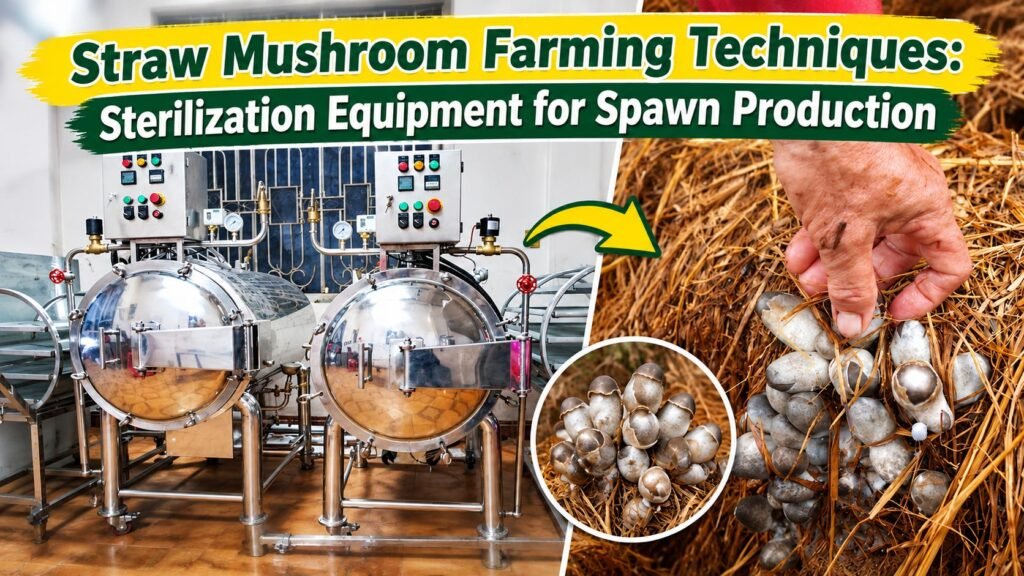
High-Yield Straw Mushrooms, Part 2: Spawn Sterilization Equipment
Across the entire process of growing high-yield straw mushrooms, spawn production is the step that directly determines both the yield and the genetic purity of the whole crop — and it’s also the step that demands the strictest technique. In this guide, VNmushrooms Farm walks growers through the essential sterilization equipment used to produce straw mushroom spawn that meets quality standards.
Straw Mushroom Spawn: Types and Grades
Straw mushroom spawn falls into two types based on substrate structure: solid spawn and liquid spawn. Classified by propagation sequence, spawn is divided into three grades: mother spawn, Grade I spawn, and production spawn.
Classification by substrate structure:
| Spawn Type | Characteristics |
| Solid spawn | Includes manure-straw spawn, grain spawn, and similar substrates |
| Liquid spawn | Cultured in a liquid medium |
Classification by propagation sequence:
| Grade | Also Known As |
| Mother spawn | First-generation spawn |
| Grade I spawn | Second-generation spawn |
| Production spawn | Third-generation spawn |
One important point worth noting: straw mushroom spawn production is an asexual reproduction process — no genetic recombination takes place — so the genotype stays fundamentally unchanged from mother spawn through Grade I and all the way to production spawn. In other words, grading straw mushroom spawn — particularly the line between Grade I and production spawn — is really just a matter of convention.
In practice, differences between straw mushroom spawn grades don’t come from the spawn’s inherent traits. They mostly come down to latent contamination introduced during production, which can leave production spawn less pure than Grade I spawn.
Sterilization Equipment for Straw Mushroom Spawn Production
Sterilization equipment used in straw mushroom spawn production falls into two categories. The first is a high-pressure, high-temperature steam autoclave (100–196 kPa, above 125°C), suited to large-scale, formal straw mushroom operations. The second is an atmospheric-pressure steam sterilization chamber, which comes in several build styles, costs less to set up, is safer to operate, and suits small-scale household producers.
| Equipment Type | Temperature / Pressure | Advantages | Best Suited For |
| High-pressure autoclave | 100–196 kPa, above 125°C | High throughput efficiency | Formal, large-scale straw mushroom operations |
| Atmospheric-pressure chamber | Under 100°C, held continuously for 8+ hours | Economical, easy to self-build, preserves more substrate nutrients | Small household producers (trade-off: slower and uses more fuel) |
| Multipurpose steam chamber | 100–103°C | Balances efficiency and safety; costs roughly 12 million VND | Household producers processing 2–3 tons of material per batch |
High-Pressure Steam Sterilization Equipment
A high-pressure steam sterilizer used in straw mushroom spawn production is built and functions as follows:
Construction and Function of a High-Pressure Steam Sterilizer
| Component | Function |
| Sterilization chamber | Where bottles or bags of straw mushroom spawn are loaded for sterilization |
| Pressure gauge | Displays the internal pressure and temperature |
| Air-release valve | Purges cold air |
| Safety valve | Automatically vents steam to relieve pressure once it exceeds the set limit |
Common high-pressure steam sterilizers include portable autoclaves, horizontal cylindrical autoclaves, and horizontal box-style sterilization cabinets.
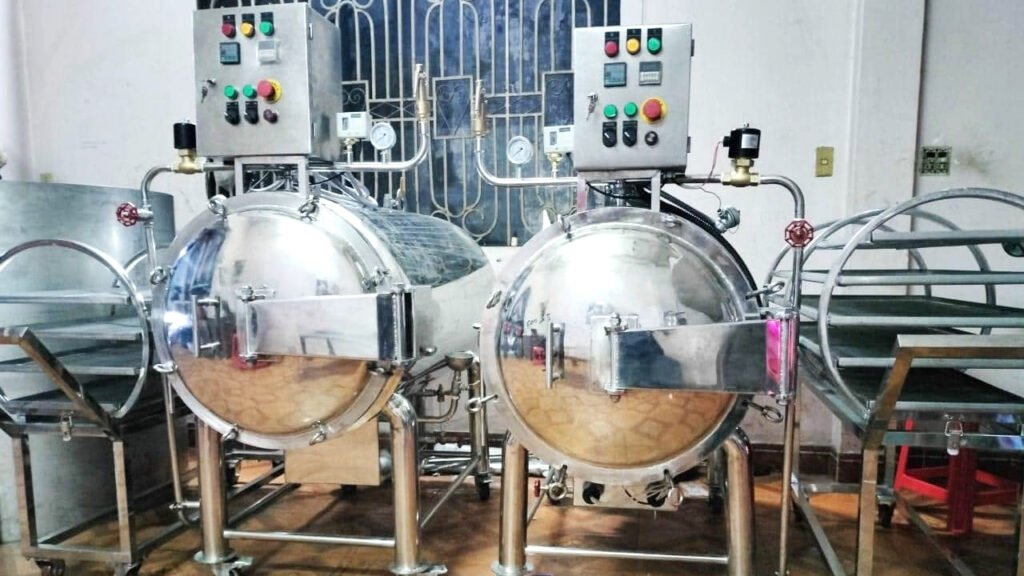
When using a high-pressure autoclave for straw mushroom spawn production, growers should keep two points in mind:
- First: bottles or bags of spawn inside the chamber must be loaded at an appropriate density so steam can circulate freely, with no dead pockets.
- Second: all cold air must be fully purged from the chamber. After steam is introduced, open the air-release valve; as the internal temperature rises, cold air is gradually pushed out. Once a strong, steady stream of steam starts venting from the valve, close it. After sterilization finishes, let the chamber cool naturally. Once the pressure gauge returns to zero, open the lid about a quarter of the way to use the residual heat to dry out the cotton plugs and prevent condensation from sudden cooling. Then remove the bottles or bags while still hot and move them to a clean cooling room.
Atmospheric-Pressure Steam Sterilization Chamber
Most household straw mushroom producers rely mainly on atmospheric-pressure steam sterilizers, since they’re highly cost-effective and can be self-built.
Key points for building an atmospheric-pressure steam sterilizer for straw mushroom spawn production:
- Build the steam chamber on the furnace base using brick and cement, about 100 cm tall; the lid is made from galvanized sheet metal in a cone shape, with a hole at the top for inserting a thermometer.
- Install a preheating water tank along the flue between the chamber and the chimney. Residual heat from the flue gas warms the water in this tank, and the hot water is then continuously fed into the sterilization chamber to replace lost water, saving energy.
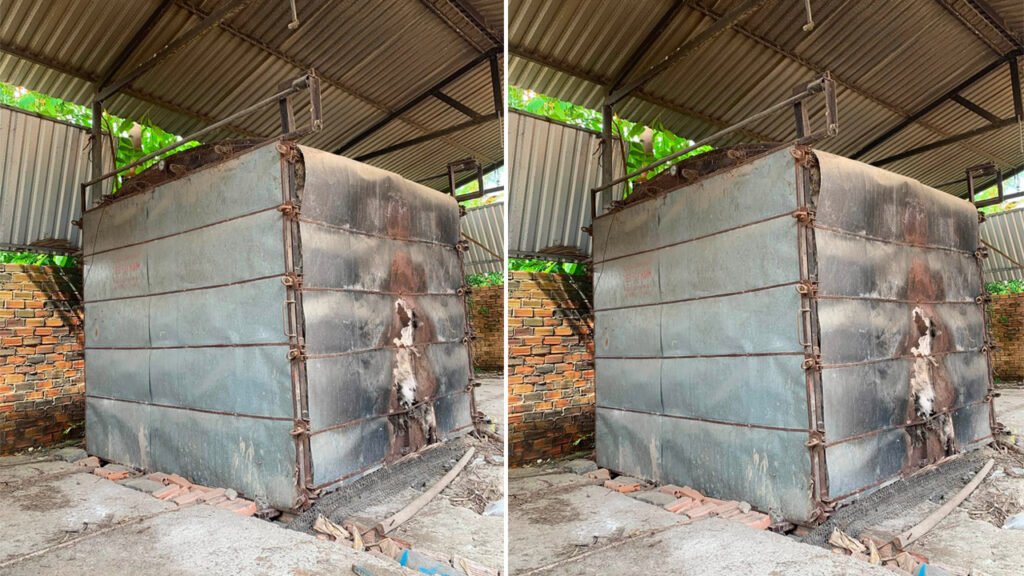
When sterilizing straw mushroom spawn with atmospheric-pressure steam, growers should keep the following points in mind:
- Bags or bottles of spawn inside the chamber shouldn’t be packed too tightly. Separate each layer with trays or metal baskets so steam circulates evenly throughout.
- When lighting the fire to build steam, open the lower vent to release cold air. Once steam is venting out strongly and continuously, close the vent. Once the temperature hits 100°C, start timing and hold it there continuously for more than 8 hours.
- Before lighting the fire, fill both the sterilization chamber and the external water tank with enough water. Monitor the water level throughout sterilization and top it up promptly to avoid running dry and scorching the chamber.
- Throughout the sterilization run for straw mushroom spawn, fire intensity should follow a strong-heat, steady-hold, cool-down sequence.
In practice: start with a strong fire so the temperature climbs to 100°C quickly — ideally within 3–4 hours — since heating too slowly extends the process and lets the substrate turn sour.
Once it reaches 100°C, hold it steady; letting the temperature swing up and down hurts sterilization effectiveness. After the full sterilization time is reached, stoke the fire briefly once more, then let the chamber cool gradually. Don’t open the lid and remove material until the temperature drops to 60°C.
Multipurpose Steam Sterilization Chamber
A multipurpose steam chamber for straw mushroom spawn production combines the high throughput of a high-pressure autoclave with the safety and low cost of an atmospheric-pressure steam chamber.
It sterilizes at 100–103°C, making it a solid fit for small household straw mushroom producers who don’t have much capital to invest.
When using a multipurpose steam chamber for straw mushroom spawn production, substrate bags can be stacked in a trapezoid pile, typically 8–12 layers deep. Spawn bottles can be loaded into baskets for sterilizing.
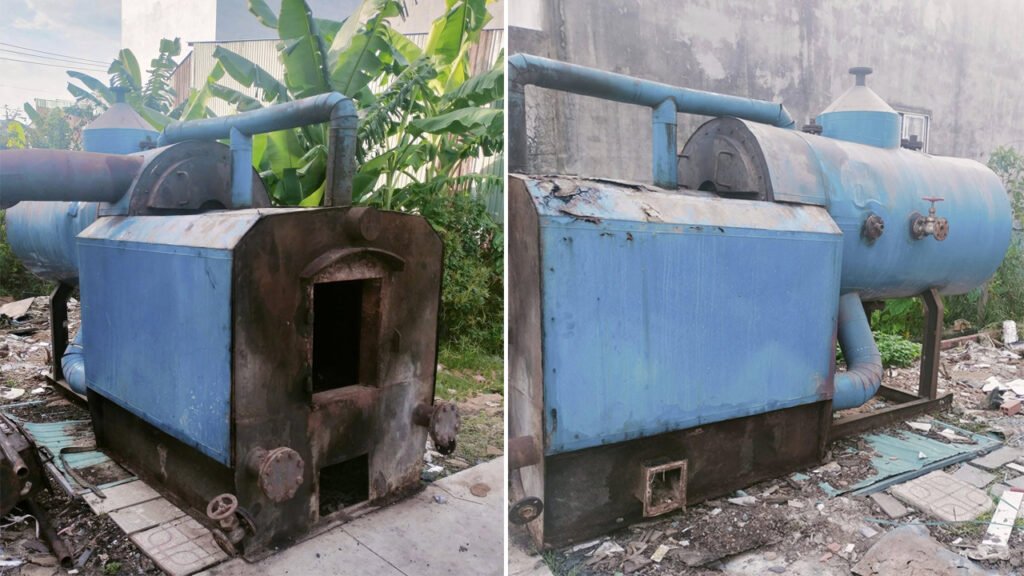
Each run, a multipurpose steam chamber can process 2–3 tons of material. Once everything’s stacked, cover the pile with two layers of plastic sheeting, then an outer layer of tarp or straw matting to retain heat. Weigh down the edges of the plastic and tarp with bricks or other heavy objects so steam pressure doesn’t blow the covering loose.
Once set up, feed the chamber’s steam pipe into the gap between the bamboo poles or bricks at the bottom of the pile, then fill the chamber with water up to the marked level.
Check that the water gauge and pressure gauge are working properly. Build a strong fire for 10–20 minutes until the chamber’s steam pressure reaches 49 kPa. At that point, open the release valve to feed steam into the material pile.
After 2 hours, the material’s internal temperature can reach above 100°C. The working pressure of a multipurpose steam chamber is 49 kPa; if it exceeds that, the chamber automatically vents pressure, making it safe and reliable. Under a strong fire, coal consumption runs about 20–26 kg/hour; holding a moderate fire brings that down to roughly 6–8 kg/hour.
Water consumption under a strong fire is around 90 liters/hour, generating 90–120 m³ of steam per hour. Once the temperature at the center of the material pile hits 90°C, keep the fire going for another 5–6 hours before stopping. Once the bags cool to around 30°C, it’s time to inoculate the spawn.
Frequently Asked Questions
What does it cost to get started producing straw mushroom spawn on a small scale?
It depends on the equipment you choose. Building your own atmospheric-pressure chamber and using an inoculation box instead of a dedicated clean room keeps startup costs significantly lower than investing in a high-pressure autoclave or a multipurpose steam chamber (roughly 12 million VND). It’s worth starting small with basic equipment, then upgrading once you’ve got the technique down.
What sterilization equipment makes sense for household-scale spawn production?
For small-scale production, an atmospheric-pressure steam chamber is the best fit — low investment cost, can be self-built, and safer to operate, even though it takes longer and burns more fuel than high-pressure equipment.
How do you know a sterilization run actually reached a high enough temperature to kill off contaminant microbes?
You can use a probe thermometer or a maximum-registering thermometer, or make a simple heat indicator yourself using benzoic acid crystals sealed in a glass tube — if the crystals have melted after sterilization, that confirms the temperature reached 121°C.
Does solid spawn and liquid spawn need different sterilization equipment?
The sterilization principle is the same for both, but in practice they’re usually handled differently: solid spawn (bottles or bags) is sterilized in the autoclave or steam chamber types covered above, while liquid spawn is typically cultured and sterilized in specialized fermentation vessels rather than a standard steam chamber.
For a high-quality, high-yield straw mushroom crop, growers should research and invest properly from the start in these four areas:
- Sterilization equipment for straw mushroom spawn production
- Facilities for straw mushroom spawn production
- Equipment and tools for straw mushroom spawn production
- Chemicals used in straw mushroom spawn production
Follow the 5-part series our engineering team at VNmushrooms Farm has put together to dig deeper into straw mushroom spawn production technique — and if you’d like to talk through a process that fits your production scale, don’t hesitate to reach out to us for guidance.
- High-Yield Straw Mushrooms, Part 7: Grade II & III Spawn
- High-Yield Straw Mushrooms, Part 6: Mother Spawn Production
- High-Yield Straw Mushrooms, Part 4: Heating, Humidity & Tools
- High-Yield Straw Mushrooms, Part 5: Common Chemicals Used
- High-Yield Straw Mushrooms, Part 2: Spawn Sterilization Equipment
Bài viết cùng chủ đề:
-
Growing Straw Mushrooms on Cotton Waste: Outdoor & Indoor
-

Growing Straw Mushrooms on Cottonseed Hulls: Outdoor & Indoor
-

10 High-Quality Straw Mushroom Strains: Selection Guide
-
High-Yield Straw Mushroom Growing: Part 9 – Setup & Disinfection
-

High-Yield Straw Mushrooms, Part 8: Spawn Quality & Storage
-
High-Yield Straw Mushrooms, Part 7: Grade II & III Spawn
-
High-Yield Straw Mushrooms, Part 6: Mother Spawn Production
-
High-Yield Straw Mushrooms, Part 5: Common Chemicals Used
-
High-Yield Straw Mushrooms, Part 4: Heating, Humidity & Tools
-
High-Yield Straw Mushrooms, Part 3: Inoculation Rooms & Spawn Run
-
Straw Mushroom Growth Stages: When to Harvest for Best Yield
-

Straw Mushroom Farming: Low-Cost, High-Return Business