

High-Yield Straw Mushroom Growing: Part 9 – Setup & Disinfection
Straw mushrooms can be grown indoors or outdoors and can achieve high yields and good quality if growers know how to properly set up and disinfect the growing area. VNmushrooms Farm will guide growers on how to set up and disinfect straw mushroom growing areas in this article!
When growing straw mushrooms indoors, the focus is on setting up the growing house, arranging the equipment, and carrying out proper disinfection. Growing straw mushrooms outdoors is more challenging because growers must select suitable soil and water sources, know how to prepare growing beds, and apply measures to eliminate insects and contaminants.
Setting Up and Disinfecting an Indoor Straw Mushroom Growing House
-
Setting Up the Straw Mushroom Growing House
The specifications for setting up an indoor straw mushroom growing area are as follows:
| Item | Requirement/Specification |
| Lighting | Diffused light |
| Aisle | Approximately 0.7 m |
| Rack width | Approximately 1 m |
| Optimal number of tiers | 3–4 tiers |
| Maximum number of tiers | 5–6 tiers |
| Distance between tiers | 0.65–0.8 m |
| Rack surface and bottom | Level surface; preferably line the bottom with plastic sheeting, although reed mats, rush mats, or straw can also be used. |
A straw mushroom growing house should have diffused light, be able to retain heat and moisture, and allow convenient ventilation and air exchange. Straw mushroom growing racks can be made of reinforced concrete, bamboo, or wood, and must be sturdy.
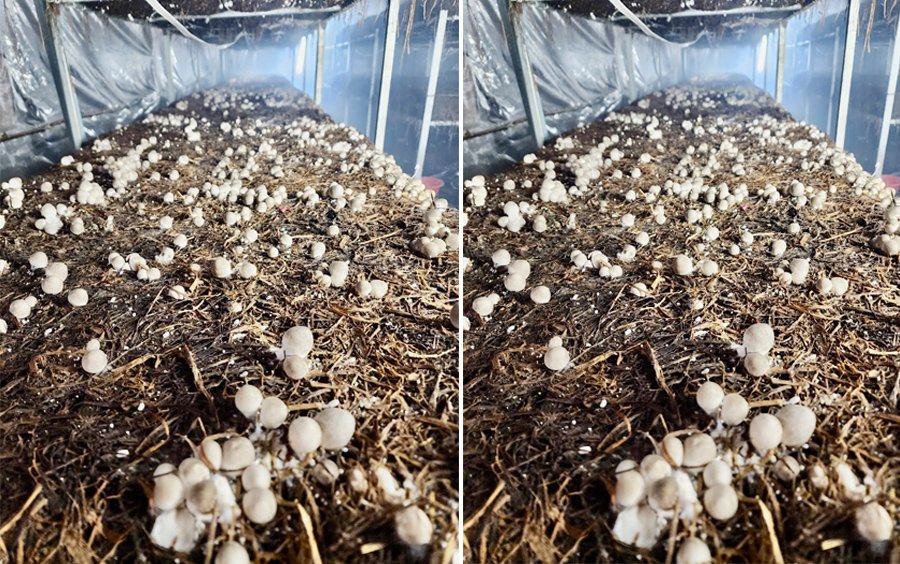
The four sides of the mushroom racks should preferably not be placed directly against the walls, and the aisles should be approximately 0.7 m wide. The rack width should be approximately 1 m to facilitate handling and mycelial growth; if the rack is too wide, the mycelium in the middle of the rack often grows poorly.
Read more: Straw Mushroom Cultivation Techniques, Part 8: How to Evaluate and Preserve Spawn.
The optimal number of rack tiers is 3–4 tiers, with a maximum of 5–6 tiers. The distance between tiers is 0.65–0.8 m, and the lowest tier can be placed close to the ground. The rack surface should be level; it is best to line the bottom with plastic sheeting, although reed mats, grass mats, or straw can also be used.
-
Disinfecting the Straw Mushroom Growing House
Before use, the straw mushroom growing house must be thoroughly disinfected, especially growing houses that have been used many times. Otherwise, contamination by undesirable microorganisms or the emergence of harmful insects can easily occur, leading to production failure.
There are many disinfection methods, which can be selected depending on the specific conditions of each facility. VNmushrooms Farm introduces some commonly used disinfectants for straw mushroom growing houses and their methods of use in the table below.
| Method | Main Specifications | Content/Notes in the Document |
| Sulfur | Approximately 15 g of sulfur per 1 m³ of space. | Seal the growing house and burn sulfur for fumigation. |
| Formaldehyde + potassium permanganate | For each 1 m³ of space, use approximately 10 ml of 40% formaldehyde solution combined with 4 g of potassium permanganate. | Seal the straw mushroom growing house. Formaldehyde has strong bactericidal properties but is less effective against insects, so protective measures should be taken. |
| Bleaching powder | 1 kg of bleaching powder (containing 30% available chlorine) + 30 liters of water produces a solution containing 1% available chlorine. Spray 225 ml of this solution per m² of growing-house surface. | Sealing is not required; mix and use immediately. Bleaching powder is corrosive, so personal protective measures should be taken during handling. |
| Sulfur + formaldehyde + DDVP | For each 1 m³ of space: 5 g sulfur + 1 g DDVP + 2 ml of 40% formaldehyde solution, mixed with sawdust and heated. | Fumigate under sealed conditions for 24 hours, then ventilate and exchange the air. |
| Carbolic acid | 5% solution (dissolve 50 g of carbolic acid in enough water to make 1,000 ml) | Spray for disinfection inside the room or disinfect equipment. |
| Bordeaux mixture | 1% Bordeaux mixture (prepared from 1% copper sulfate, 1% quicklime, and 98% water) | Spray approximately 225 ml of the solution per square meter of area. |
| Ultraviolet light | – | Ultraviolet lamps can be installed where conditions permit. |
Reference: Straw Mushroom Cultivation Techniques, Part 7: How to Make Generation 2 and Generation 3 Spawn.
Setting Up and Disinfecting an Outdoor Straw Mushroom Growing Area
How Should You Choose an Outdoor Straw Mushroom Growing Area?
The ideal outdoor straw mushroom growing area should have loose, fertile, well-drained sandy loam soil (consisting of 4 parts sand and 6 parts soil). This type of soil has good heat retention, moisture retention, nutrient storage, and aeration, which are beneficial for the growth and development of straw mushroom mycelium and fruiting bodies.
The straw mushroom growing area should be close to a water source to facilitate soaking straw and watering, helping save labor. The water used for watering mushrooms must be clean, free from contamination, and free of unpleasant odors.
Read more: Straw Mushroom Cultivation Techniques, Part 6: Master Spawn Production Process.
What Should You Keep in Mind When Growing Straw Mushrooms Outdoors?
Straw mushrooms should not be grown outdoors if the growing area has sandy soil with poor water retention, soil that is too sticky, or soil with high salt content.
When air temperatures are low, choose a wind-sheltered location with sunlight and make use of sunlight to increase the temperature of the substrate pile. When air temperatures are high, grow mushrooms under shade structures, in shaded and well-ventilated areas, or under trees, bottle gourd trellises, or pumpkin trellises.
How to Grow Straw Mushrooms Outdoors on a Large Scale
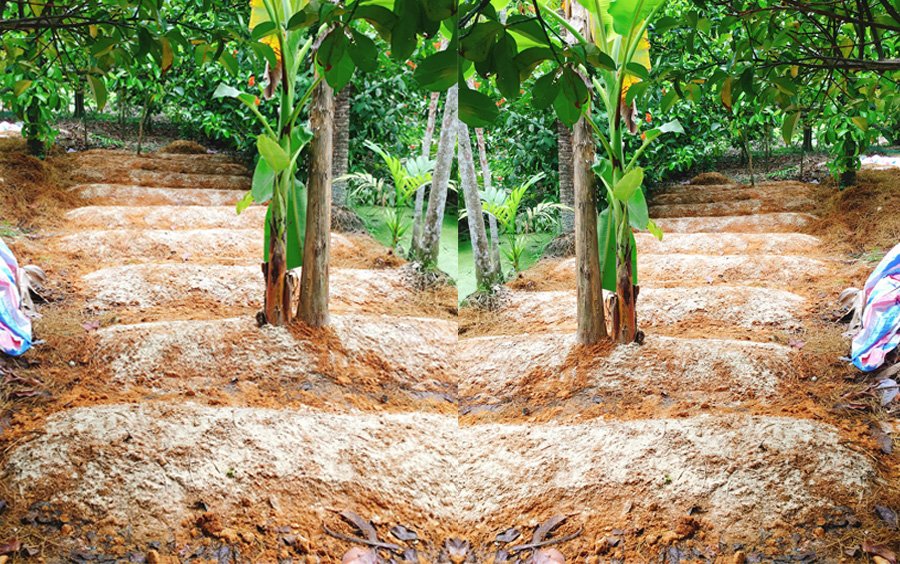
When growing straw mushrooms outdoors over a large area, first dig a drainage ditch around the growing area, 20–26 cm wide and 20 cm deep, to drain standing water.
When preparing the growing beds, first turn over the soil (normally to a depth of 15–20 cm), lightly compact the middle section, while leaving the two sides looser. The growing bed should be approximately 100 cm wide. After preparing the growing beds, water them to moisten the soil.
Next, use water soaked with tea seed cake, or pesticides belonging to the pyrethroid group, or water soaked with tobacco leaves, ammonia water, limewater, bleaching powder, and so on, to eliminate harmful insects and contaminants in the growing area.
Read more: Substrates Used for High-Yield Straw Mushroom Cultivation.
When temperatures are low, the growing beds should be oriented east–west so that the mushroom racks receive sunlight evenly. When temperatures are high, the growing beds should be oriented north–south to receive the southern wind evenly, helping maintain uniform temperature, moisture, and ventilation throughout the substrate pile.
VNmushrooms Farm provides the following summary table of specifications for setting up a large-scale outdoor straw mushroom growing area:
| Item | Specification/Content |
| Sandy loam soil ratio | 4 parts sand, 6 parts soil |
| Drainage ditch | Around the growing area, 20–26 cm wide and 20 cm deep |
| Bed orientation at low temperatures | East–west |
| Bed orientation at high temperatures | North–south |
| Bed width | Approximately 100 cm |
| Soil turning depth | Normally 15–20 cm |
Growing Straw Mushrooms: Frequently Asked Questions
- What size should a straw mushroom growing rack be?
The width of a straw mushroom growing rack should be approximately 1 m to facilitate handling and mycelial growth; if the rack is too wide, the mycelium in the middle of the rack often grows poorly. The optimal number of tiers is 3–4 tiers, with a maximum of 5–6 tiers. The distance between tiers is 0.65–0.8 m, and the lowest tier can be placed close to the ground.
- Does the straw mushroom growing house need to be disinfected multiple times after each growing cycle?
Yes. The straw mushroom growing house should be disinfected multiple times after each growing season using the chemicals and methods mentioned above by VNmushrooms Farm to reduce the risk of contamination by undesirable microorganisms or the emergence of harmful insects.
- How should you choose an area for growing straw mushrooms outdoors?
The outdoor straw mushroom growing area should ideally have loose, fertile, well-drained sandy loam soil (consisting of 4 parts sand and 6 parts soil). The straw mushroom growing area should be close to a water source to facilitate soaking straw and watering, helping save labor. The water used for watering mushrooms must be clean, free from contamination, and free of unpleasant odors.
- What should straw mushroom growers do when the weather changes?
When air temperatures are low, choose a wind-sheltered location with sunlight and make use of sunlight to increase the temperature of the substrate pile. When air temperatures are high, grow mushrooms under shade structures, in shaded and well-ventilated areas, or under trees, bottle gourd trellises, or pumpkin trellises.
VNmushrooms Farm has provided growers with technical criteria and methods for growing straw mushrooms indoors and outdoors to achieve high yields and efficiency. Growers, please apply these methods, and if you encounter any difficulties, contact the VNmushrooms Farm engineering team for the best support!
- High-Yield Straw Mushrooms, Part 3: Inoculation Rooms & Spawn Run
- Straw Mushroom Farming: Low-Cost, High-Return Business
- High-Yield Straw Mushroom Growing: Part 9 – Setup & Disinfection
- High-Yield Straw Mushrooms, Part 5: Common Chemicals Used
- High-Yield Straw Mushrooms, Part 6: Mother Spawn Production
Bài viết cùng chủ đề:
-

High-Yield Straw Mushrooms, Part 8: Spawn Quality & Storage
-

High-Yield Straw Mushrooms, Part 7: Grade II & III Spawn
-
High-Yield Straw Mushrooms, Part 6: Mother Spawn Production
-
High-Yield Straw Mushrooms, Part 5: Common Chemicals Used
-

High-Yield Straw Mushrooms, Part 4: Heating, Humidity & Tools
-
High-Yield Straw Mushrooms, Part 3: Inoculation Rooms & Spawn Run
-
High-Yield Straw Mushrooms, Part 2: Spawn Sterilization Equipment
-
Straw Mushroom Growth Stages: When to Harvest for Best Yield
-

Straw Mushroom Farming: Low-Cost, High-Return Business