
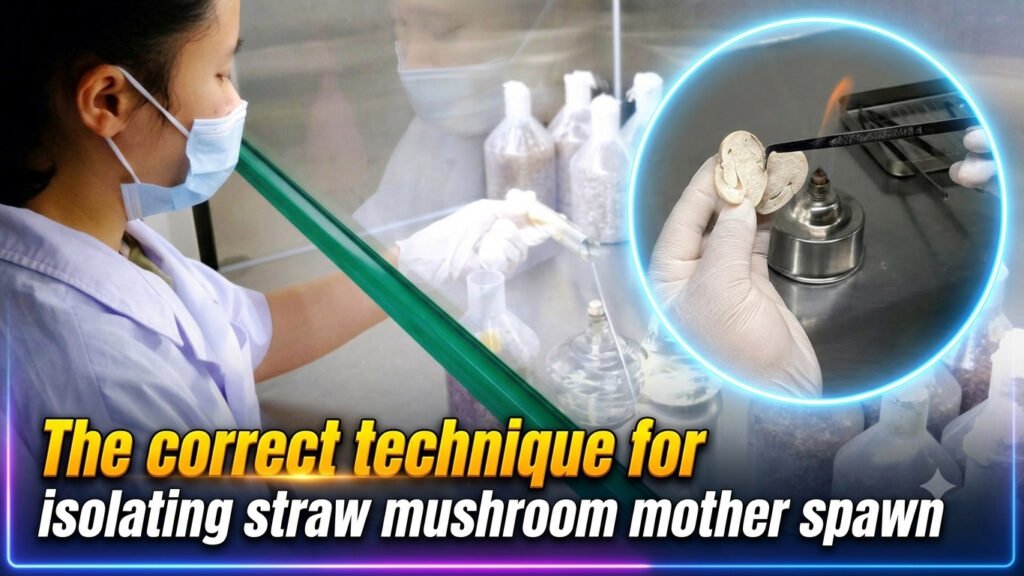
High-Yield Straw Mushrooms, Part 6: Mother Spawn Production
The quality of straw mushroom spawn determines the yield of the entire crop that follows — and during production, there are clear signs that let growers tell a standard-grade spawn bottle or bag apart from a problem one.
In this guide, the VNmushrooms Farm engineering team walks through how to “read” the quality of a straw mushroom spawn bottle or bag to know whether it meets the standard.
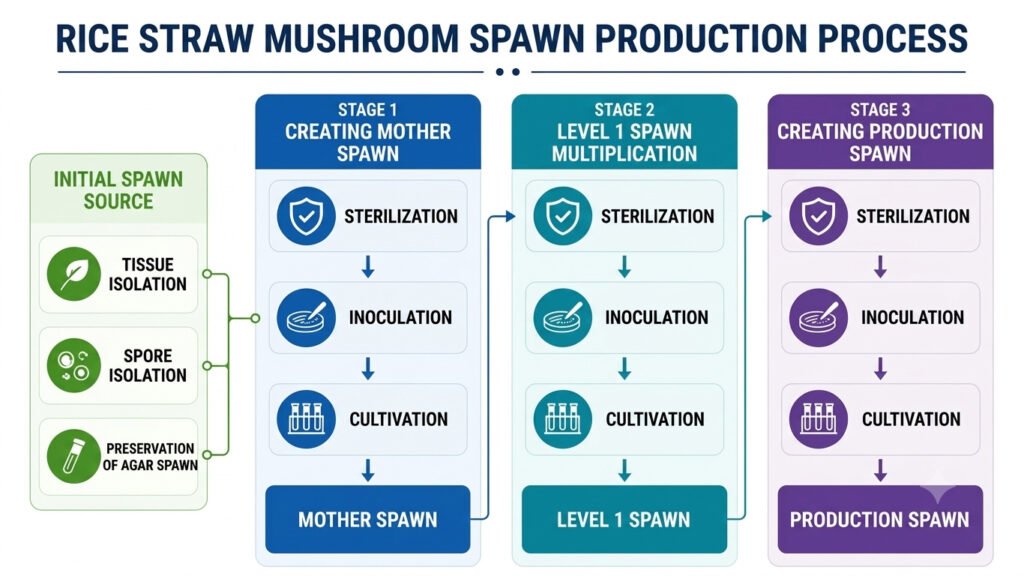
As a general rule, straw mushroom spawn production is divided into three grades: mother spawn, Grade I spawn, and production spawn. The straw mushroom spawn production process is outlined in the table below:
Preparing the Mother Spawn Culture Medium
Mother Spawn Isolation Media Formulas
There are 6 formulas commonly used for isolating straw mushroom mother spawn (measurements per 1,000 ml of water):
| Formula | Ingredients |
| Formula 1 | Peeled potato 200 g, agar 20 g, glucose 20 g |
| Formula 2 | Peeled potato 200 g, agar 20 g, glucose 20 g, potassium dihydrogen phosphate 2 g, magnesium sulfate 1 g |
| Formula 3 | Peeled potato 200 g, agar 20 g, glucose 20 g, potassium dihydrogen phosphate 2 g, magnesium sulfate 2 g, ammonium sulfate 3 g, vitamin B₁ 0.5 mg |
| Formula 4 | Peeled potato 200 g, agar 20 g, glucose 20 g, ammonium sulfate 3 g, yeast extract 6 g |
| Formula 5 | Agar 20 g, glucose 20 g, potassium dihydrogen phosphate 0.6 g, magnesium sulfate 0.5 g, vitamin B₁ 0.5 mg |
| Formula 6 | Agar 20 g, potassium dihydrogen phosphate 0.64 g, glucose 20 g, dipotassium phosphate 1 g, magnesium sulfate 0.5 g, vitamin B₁ 0.5 mg |
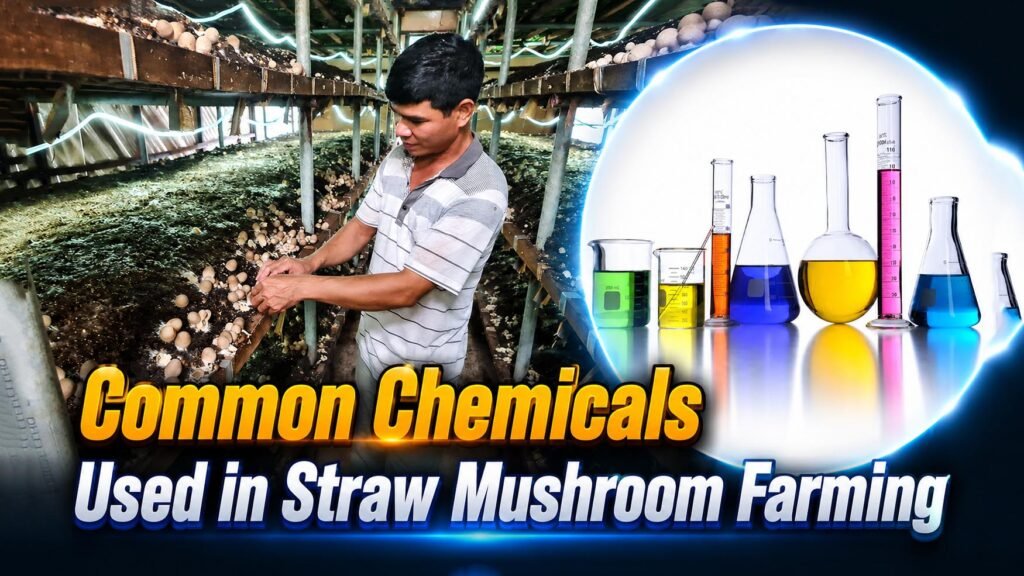
Worth reading: Common Chemicals for Effective, High-Yield Straw Mushroom Farming.
When preparing media for isolating straw mushroom mother spawn, keep the following in mind:
- Glucose can be substituted with sucrose in the same amount.
- Agar can be increased to about 25 g in summer when temperatures are high, and reduced to 18 g in winter.
- Where possible — especially in areas with hard water — use distilled water to prepare the medium.
- Use a 40% NaOH solution to adjust the medium’s pH to 7.5–8, which better suits mycelium growth.
- If you only need one medium for producing mother spawn and propagating it into Grade I spawn, Formula 1 alone is sufficient.
If the goal is long-term spawn storage, choose a formula containing potassium dihydrogen phosphate — it acts as a buffer that slows the drop in pH, making it well-suited for storing spawn over extended periods.
Sterilizing the Culture Medium
Sterilizing the culture medium is meant to completely eliminate microorganisms and create a sterile environment for straw mushroom mycelium to grow, resulting in spawn with a pure mycelial culture.
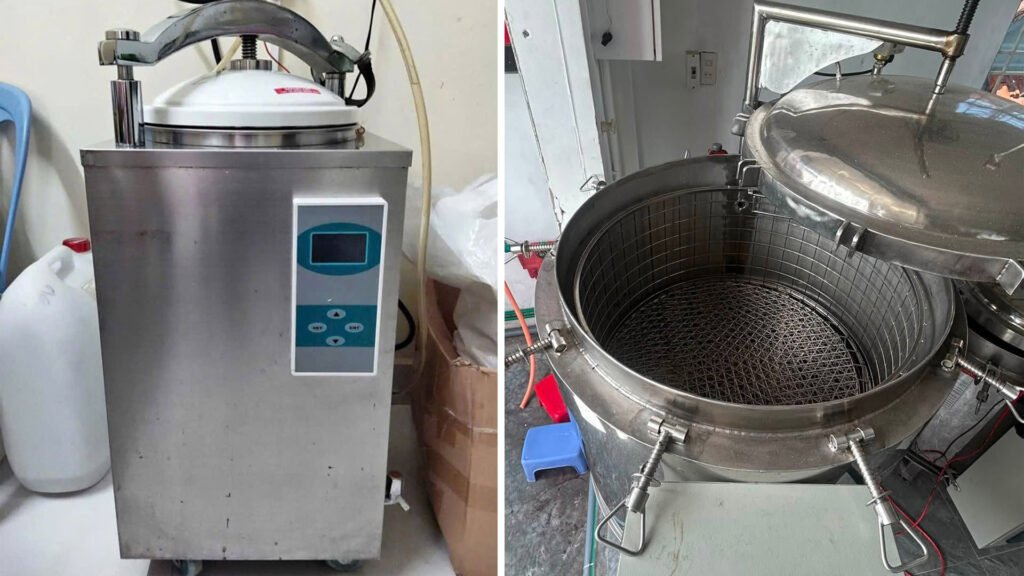
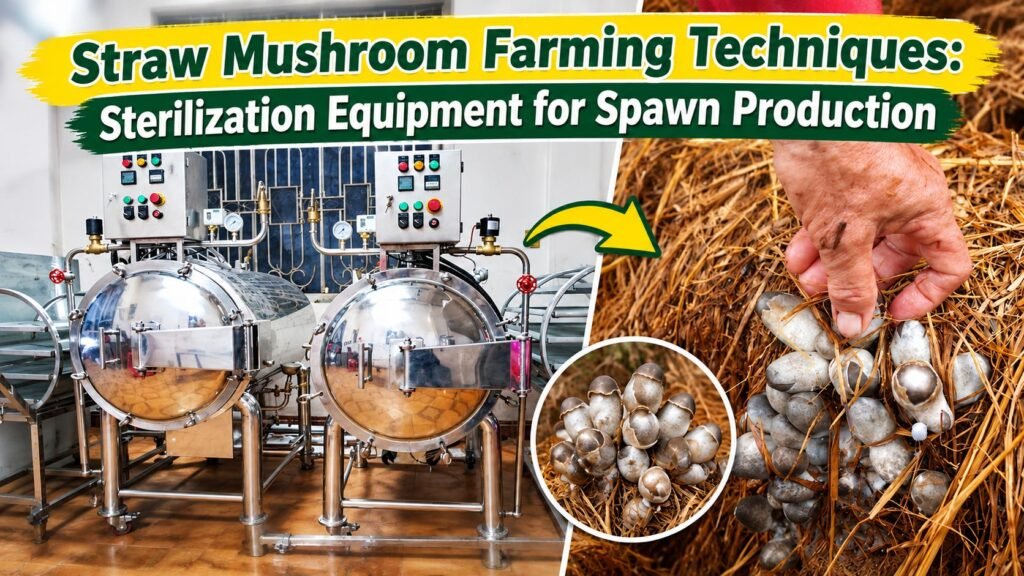
For sterilizing straw mushroom mother spawn medium (test-tube spawn), a high-pressure steam autoclave is the best choice. Sterilizing with a high-pressure steam autoclave is a moist-heat sterilization method that delivers high effectiveness and reliable sterilization quality.
Technique for Producing Straw Mushroom Mother Spawn
Methods for isolating straw mushroom mother spawn fall into two main approaches: tissue isolation and spore isolation.
Read more: Sterilization Equipment for Straw Mushroom Spawn Production.
Producing Mother Spawn: Selecting the Isolation Sample
Fruiting body samples used for isolation should come from beds where the mycelium grows fast, fruits early, has a low death rate, produces over a long harvest window, and delivers high, consistent yield.
Choose sample fruiting bodies that are large, with a short stem and a thick volva.
Before isolating straw mushroom mother spawn, sterilize the isolation tools and the work area.
Producing Mother Spawn: Tissue Isolation Method
Place the fruiting body to be isolated into a sterilized inoculation box. Then sterilize both hands and all working tools with 70% alcohol.
Wipe the surface of the fruiting body clean with alcohol-soaked cotton, then use a knife to split the fruiting body lengthwise down the middle into two equal halves.
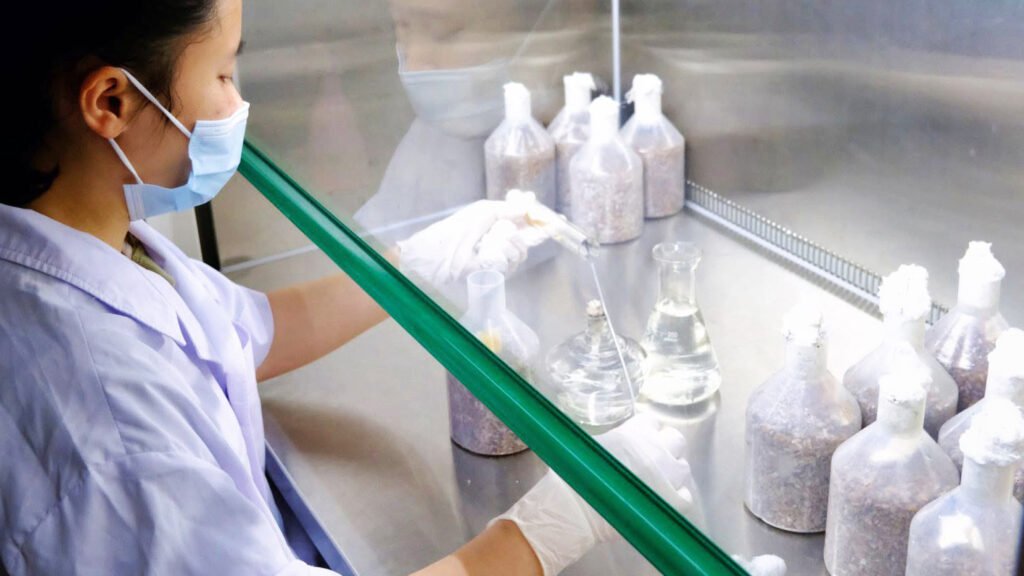
Cut a small piece of tissue from the point between the cap and the stem, then quickly inoculate it into the center of the test-tube medium and incubate the isolated tissue at 33–35°C.
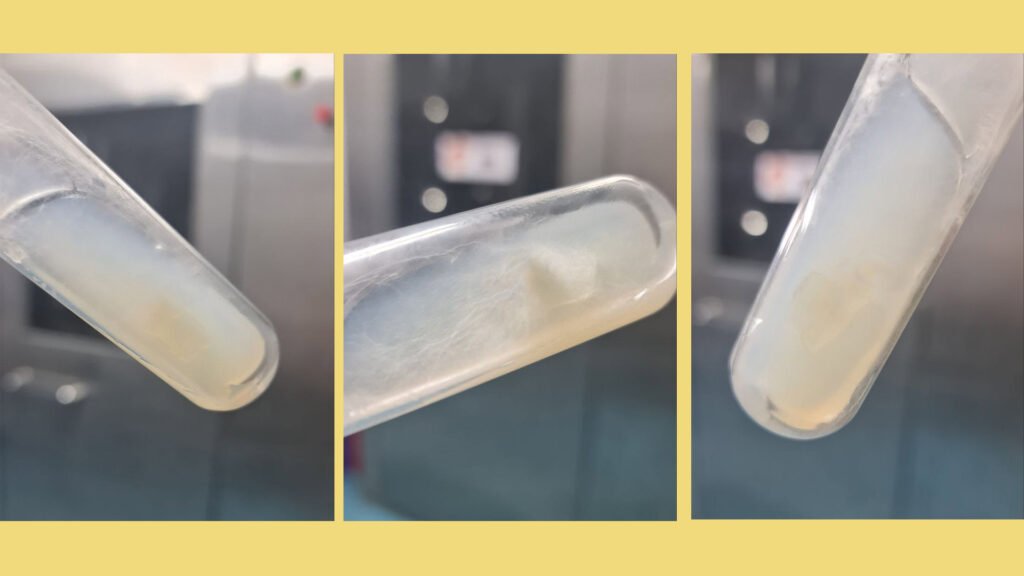
Signs of a Successful Mother Spawn Isolation:
| Timeframe | Sign |
| After 3–4 days | Thin, sparse white mycelium appears around the isolated tissue sample |
| After about 1 week | The entire slant agar surface is covered by a thick layer of white mycelium |
| With further incubation | The mycelium turns pale yellow, with small, dot-like, thick-walled reddish-purple spores appearing |
Signs of a Failed Isolation:
| Symptom | Cause |
| Slimy, white or red colonies appear | Bacterial or yeast contamination |
| Green, yellow, black, or similar coloring appears | Contamination by fungi such as Penicillium, Aspergillus, Rhizopus, etc. |
Any test tube showing a failed isolation should be discarded immediately. Test tubes with a successful isolation are transferred and cultured once more on potato dextrose agar (PDA) medium to establish the straw mushroom mother spawn.
Producing Mother Spawn: Spore Isolation Method
For straw mushroom spawn production technique, the tissue isolation method alone is enough to achieve a pure culture, while spore isolation is considerably more involved. VNmushrooms Farm recommends reserving spore isolation for breeding and variety development work only.
Reference: A Complete Rundown of Equipment for Straw Mushroom Spawn Production.
Straw Mushroom Spawn Isolation: Frequently Asked Questions
Which formula should I use for a simple, high-success-rate straw mushroom mother spawn isolation?
Formula 1 (potato 200 g, agar 20 g, glucose 20 g, water 1,000 ml) is the simplest option and gives the highest success rate for isolating straw mushroom mother spawn.
After a successful isolation, how long can straw mushroom mother spawn be stored before it needs to be transferred to Grade I spawn?
Typically, straw mushroom spawn needs to be re-transferred every 2–3 months. Spawn is usually stored in an incubator at 18–20°C. During storage, keep the temperature steady and avoid erratic swings.
Can a household pressure cooker be used to sterilize the mother spawn isolation medium?
It’s not recommended, since the contamination rate runs high. A high-pressure steam autoclave is the best choice, as it’s the most reliable sterilization method available.
Where should I source fruiting bodies for mother spawn isolation?
Sample straw mushroom populations for mother spawn isolation should come from beds where the mycelium grows fast, fruits early, has a low death rate, produces over a long harvest window, and delivers high, consistent yield. Beyond that, choose fruiting bodies that are large, with a short stem and a thick volva, to serve as your sample.
Should someone new to straw mushroom farming isolate their own spawn or buy it ready-made?
Straw mushroom mother spawn isolation technique is fairly involved and demands specific conditions and equipment. Because of that, growers just starting out with straw mushrooms should buy spawn from a reputable supplier for their cultivation and production — it’s a more reliable way to ensure quality and limit the risk of financial loss.
Mother spawn is the starting point that determines the quality of every grade that follows — which means it doesn’t just affect cultivation quality and yield, but a straw mushroom grower’s income as well.
To produce mother spawn that meets the standard, growers need to get three technical requirements right: preparing the right culture medium, sterilizing tools and the work environment properly, and following correct isolation technique.
Next in this series, we’ll walk through the technique for producing Grade II and Grade III straw mushroom spawn — the steps that carry mother spawn through to the spawn growers actually use in the field.
To fully master proper straw mushroom spawn production technique, be sure to check out the complete set of 3 guides the VNmushrooms Farm engineering team has put together:
- Straw Mushroom Mother Spawn Production Technique
- Straw Mushroom Grade II and Grade III Spawn Production Technique
- How to Evaluate and Store Straw Mushroom Spawn Quality
And if you’re running into challenges or want extra guidance to get more yield and quality out of your straw mushroom crop, don’t hesitate to reach out to the VNmushrooms Farm engineering team right away!
Bài viết cùng chủ đề:
-
Growing Straw Mushrooms on Cotton Waste: Outdoor & Indoor
-

Growing Straw Mushrooms on Cottonseed Hulls: Outdoor & Indoor
-
10 High-Quality Straw Mushroom Strains: Selection Guide
-
High-Yield Straw Mushroom Growing: Part 9 – Setup & Disinfection
-

High-Yield Straw Mushrooms, Part 8: Spawn Quality & Storage
-
High-Yield Straw Mushrooms, Part 7: Grade II & III Spawn
-
High-Yield Straw Mushrooms, Part 5: Common Chemicals Used
-
High-Yield Straw Mushrooms, Part 4: Heating, Humidity & Tools
-
High-Yield Straw Mushrooms, Part 3: Inoculation Rooms & Spawn Run
-
High-Yield Straw Mushrooms, Part 2: Spawn Sterilization Equipment
-
Straw Mushroom Growth Stages: When to Harvest for Best Yield
-

Straw Mushroom Farming: Low-Cost, High-Return Business