

High-Yield Straw Mushrooms, Part 8: Spawn Quality & Storage
Whether straw mushroom spawn is self-isolated or bought from another source, it still has to go through a fruiting trial. Only once it’s confirmed to deliver high yield and good quality should it be propagated further for expanded use. So how do you actually evaluate whether straw mushroom spawn meets the standard? Let’s walk through it in this guide.
VNmushrooms Farm lays out 3 criteria for a standard-grade straw mushroom spawn bottle/bag, along with 6 signs that a bottle/bag has failed to meet the standard. Use these benchmarks before propagating spawn for expanded production, to avoid economic loss.
Straw Mushroom Spawn Quality Requirements
3 Criteria for Standard-Grade Straw Mushroom Spawn
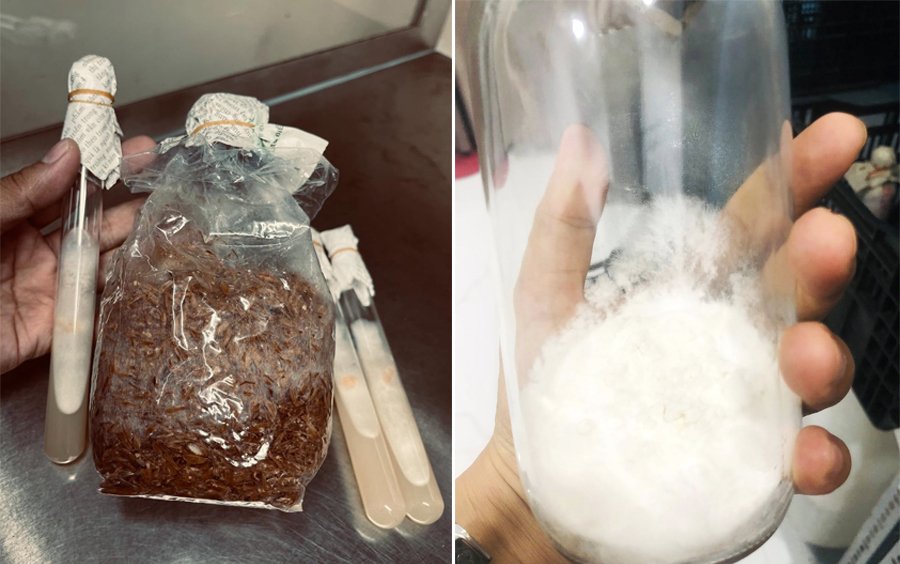
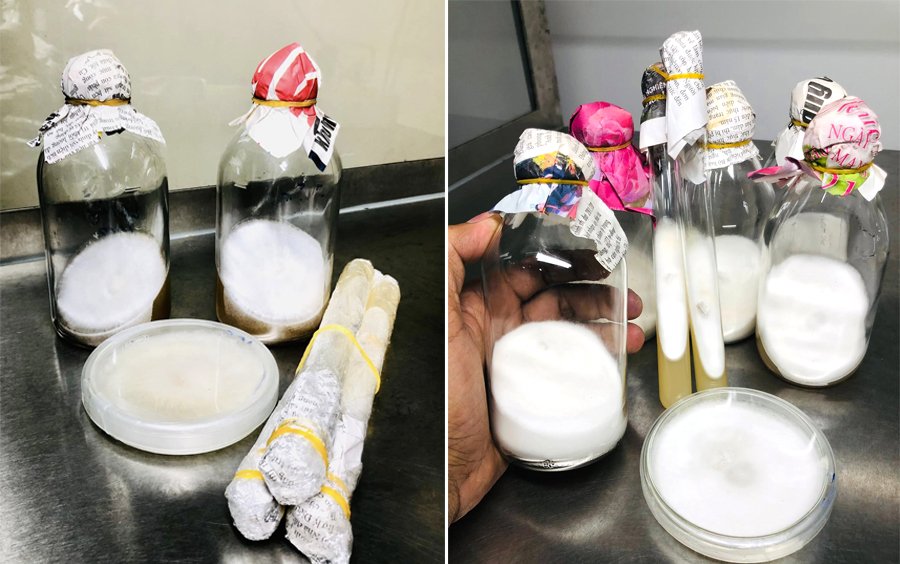
- First: the mycelium is pale yellow and translucent, with either many chlamydospores or none at all, distributed evenly throughout the entire bottle/bag, and the culture medium holds the right moisture level (around 65%).
- Second: the spawn is the right age — fresh, healthy, and vigorous.
- Third: no contamination and no unusual insects present.
6 Signs of Poor-Quality Straw Mushroom Spawn
There are 6 signs that a straw mushroom spawn bottle/bag has failed to meet quality standards. Avoid using any spawn bag showing one of the conditions below:
| Observed Sign | Cause / Notes |
| Mycelium is white and translucent, with none or very few chlamydospores | The spawn is still too young. Continue incubating until it reaches the right age before use. |
| Mycelium is growing sparser, but the medium is packed with chlamydospores; the mycelium turns yellow, dense like a thick mat, with the top layer shriveling | The spawn is too old, which significantly hurts yield — not suitable for use. |
| Mycelium is sparse, translucent, and as thin as spider silk | Poor nutrient absorption and little branching. Usually happens when the culture medium wasn’t fully sterilized, letting hay bacillus (Bacillus subtilis) thrive on the material’s surface and block nutrient uptake. Don’t use it. |
| The bag feels heavy, mycelium growth is weak, and chlamydospores have clumped into large patches | Caused by excess moisture in the medium, resulting in poor spawn quality. |
| Mycelium is gradually disappearing, with a fine, mobile powder-like layer appearing on the bag wall | Caused by mushroom mites feeding on the mycelium. This spawn needs to be discarded. |
| Mycelium grows thick and pure white, sometimes with small sclerotia; if an umbrella-shaped “ink cap” mushroom grows inside the bottle and turns to black liquid with age | The spawn is contaminated with ink cap mushroom (Coprinus) and needs to be discarded. |
Proper Straw Mushroom Spawn Storage
Storing straw mushroom spawn differs slightly from other edible mushroom species. Growers need to understand its specific characteristics and follow the straw mushroom spawn storage method below closely:
| Item | Correct Specification for Straw Mushroom |
| Storage temperature | 18–20°C, stored in an incubator |
| During summer | Where possible, storing in a biochemical incubator is best |
| Temperature stability | Keep the temperature relatively stable throughout storage — avoid sudden swings |
| Re-transfer frequency | Typically every 2–3 months |
| Note after winter | After storing through winter, re-transfer the spawn once to prevent it from aging |
| Before putting winter-stored spawn into production | Run a fruiting trial and tissue isolation to rejuvenate the spawn, ensuring high, stable yield at large-scale production |
Straw Mushroom Farming: Frequently Asked Questions
- How do you tell if straw mushroom spawn is too young or too old?
A young spawn bag will show white, translucent mycelium with none or very few chlamydospores. When the mycelium grows sparser but the medium is packed with chlamydospores, the mycelium turns yellow and dense like a thick mat, and the top layer shrivels — that’s when the spawn has gone too old.
2. Is it okay to store straw mushroom spawn in the refrigerator?
Straw mushroom spawn can be stored in the refrigerator, as long as the temperature stays at 18–20°C (a biochemical incubator is still the best option).
3. Should long-stored straw mushroom spawn bags still be used for production?
No — after long-term storage, straw mushroom spawn needs to be re-transferred, tested for fruiting rate, and rejuvenated before being used for large-scale production, to protect yield and avoid economic loss.
4. What should you check before putting purchased straw mushroom spawn into production?
Before using straw mushroom spawn for large-scale production, check the mycelium’s color and distribution, and confirm the spawn’s age. Make sure the bag shows no contamination, unusual fungi, or insect infestation.
In this guide, VNmushrooms Farm walked through how to evaluate whether straw mushroom spawn meets the standard, along with the correct technique for storing it properly.
And if you’re running into challenges or want extra guidance to get more yield and quality out of your straw mushroom crop, don’t hesitate to reach out to the VNmushrooms Farm engineering team right away!
- High-Yield Straw Mushrooms, Part 8: Spawn Quality & Storage
- High-Yield Straw Mushrooms, Part 3: Inoculation Rooms & Spawn Run
- Straw Mushroom Farming: Low-Cost, High-Return Business
- High-Yield Straw Mushrooms, Part 4: Heating, Humidity & Tools
- High-Yield Straw Mushrooms, Part 2: Spawn Sterilization Equipment
Bài viết cùng chủ đề:
-
High-Yield Straw Mushrooms, Part 7: Grade II & III Spawn
-
High-Yield Straw Mushrooms, Part 6: Mother Spawn Production
-
High-Yield Straw Mushrooms, Part 5: Common Chemicals Used
-
High-Yield Straw Mushrooms, Part 4: Heating, Humidity & Tools
-
High-Yield Straw Mushrooms, Part 3: Inoculation Rooms & Spawn Run
-
High-Yield Straw Mushrooms, Part 2: Spawn Sterilization Equipment
-
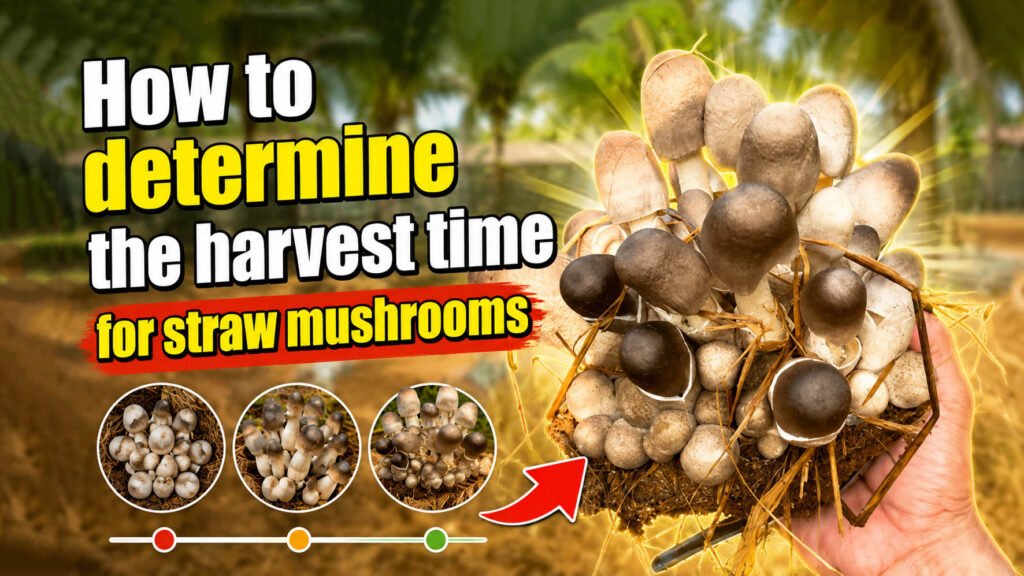
Straw Mushroom Growth Stages: When to Harvest for Best Yield
-

Straw Mushroom Farming: Low-Cost, High-Return Business